
Ketamine Research Institute · Clinical Education
The KRI Mini-Fellowship in office-based ketamine infusion therapy
A competency-based program for licensed clinicians. Four days of instruction and supervised clinical training inside a working infusion center in Sarasota, Florida, then a year of mentorship. Ketamine is taught here as what it is: an anesthetic.

Doing ketamine-assisted psychotherapy? Held in the anxiolytic–empathogenic range, the patient’s ego defenses are relaxed and they are set back from the emotion of the situation — able and willing to engage for the working part of the session, instead of in fragments around a peak. That is this method, applied to a KAP session. See what that looks like
The program in brief
The drugs will change. What the clinician must do will not.
Ketamine has been an anesthetic since 1970. What is recent is its rapid antidepressant effect, which does not work through the monoamine pathways earlier antidepressants targeted. A clinical field has grown up around that finding. Ketamine is the first drug of its kind in routine office practice, and it will not be the last: psilocybin and related compounds are in late-stage FDA review.
That is what this program trains: selecting the right patient, setting a dose that reaches the intended exposure, monitoring an altered state safely, managing what goes wrong, and measuring what the treatment achieved. In its comment to the FDA on training standards for this field, the Institute argued that these competencies should be assessed rather than assumed from attendance, and re-assessed rather than granted once. This program is built that way.

Structured like a clinical fellowship, compressed into four days and a year.
The Mini-Fellowship teaches licensed clinicians to deliver intravenous ketamine as office-based anesthesia: selecting and preparing patients, calculating each infusion from a target plasma concentration, monitoring continuously, managing the airway and adverse events, and measuring what the treatment achieves.
It is built the way clinical training is built. There is a defined curriculum with stated learning objectives, supervised practice that is observed and assessed, a formal examination, and a period of mentored independent practice afterward.
Classes are limited to four clinicians so that every participant performs every step, and time is set aside for each participant’s own practice setting, patient population and state requirements. The course director teaches each session himself. Fewer than 100 clinicians have trained in this method.
The certificate is issued when competency is demonstrated, not when the four days are over.
Four days is what it takes to teach the method and still leave a day to find out whether it was learned.
- Didactic
- Clinical
- Experiential
- Assessment
- Mentorship
- Take-home
Fifteen modules across four days: pharmacology, pharmacokinetics, regulation, safety and practice systems.Taught in a small seminar, with discussion rather than slides alone.
A supervised peer practicum in the infusion suite, from history and dose calculation to line placement, pump programming and recovery.No patients are involved.
An optional, fully monitored personal infusion, followed by a structured reflection.Voluntary and separately consented.
Four parts: a 100-question written examination, skill stations, eight case scenarios, and a review of your documentation and charts.Module 15. The skill stations run across the practicum afternoons; the examination and the case scenarios are on Day 4.
Twelve months of access to the clinical team, quarterly milestones and a competency re-assessment at twelve months.
The Clinical Companion app, the Clinical Reference Manual, KIRT-S, and complete clinical, business and compliance libraries.Listed in full below.
The research-to-practice gap
The same drug, the same number of infusions, very different results.
In a research setting, a course of six ketamine infusions for treatment-resistant depression produced a response in 70.8% of patients.10 In a large study of community practices giving essentially the same series, 53.6% responded and 28.9% reached remission. In the same study, 8.4% finished with higher depression scores than they started with, and 6.0% reported increased thoughts of suicide.6
The shortfall is not unique to community practice. A retrospective review at an academic ketamine clinic — a more refractory referral population, measured on a different instrument — found that only 18.3% of 82 patients responded to the induction series.15 That number is not comparable to the two above and is not offered as one; it is a reminder that the inherited protocol can fall a long way short in any setting.
The molecule is the same in each of these settings. What differs is how carefully patients are selected and prepared, how the dose is set, how side effects and the dissociative experience are managed, and how response is measured and acted on. Those are the things this program teaches. The section below takes the one that is easiest to get wrong without knowing it: how the dose is set.
Much of what decides the outcome is left to the clinician. A 2017 consensus statement reviewed the evidence on patient selection, dosing, monitoring and follow-up, and noted how limited the data were on several of them.5 The 0.5 mg/kg-over-forty-minutes protocol widely used in office practice came from small early trials,3,4 not from work mapping a dose-response curve — plasma concentration against clinical effect — of the kind that would establish the appropriate dose for any single indication.
Two settings, one protocol
Published figures. These are not results of this training.
Responded to the same six-infusion course
Murrough et al., 201310 · McInnes et al., 2022, across 178 practices6
And within that community cohort
finished the series with higher depression scores than they started with.6
reported increased thoughts of suicide.6
Ketamine is FDA-approved as an anesthetic. Its use for depression, chronic pain and other psychiatric indications is off-label, which means the FDA has not evaluated it for those uses.
Concentration-targeted infusion
Dosing to a concentration, not a number of milligrams.
A weight-based dose fixes how much drug goes in. It does not fix the plasma concentration a patient reaches, which depends on how that individual distributes and clears the drug, and on the other medications they take. Ketamine is metabolized mainly by CYP3A4 and CYP2B6 to norketamine and further metabolites,7,8 and common variants such as CYP2B6*6 slow that step.9
Anesthesiology addressed a version of this problem decades ago with target-controlled infusion, which uses pharmacokinetic models to calculate the rate needed to reach and hold a chosen concentration.11 The course applies the same reasoning to ketamine: choose a target for the indication, calculate the infusion for the individual patient, and adjust it with what monitoring shows.
Concentration-targeted infusion, in depth →
Precision medicine in ketamine therapy →
The target window for a forty-minute infusion
Schematic. The aim is for the peak concentration at the end of the infusion to fall inside the target range. The target values themselves are taught in the course. Sources: Clements and Nimmo 1981; Zarate et al. 2012; KRI dose–response data.12,13
Why weight-based dosing misleads
Same weight, same dose, three different plasma levels.
Three patients who each weigh 70 kg receive the same 0.5 mg/kg dose, and the peak concentration lands below, inside and above the target range. Clearance and volume of distribution differ substantially from one person to the next.
The largest pooled analysis of ketamine pharmacokinetics found no patient characteristic that reliably predicts where an individual will land.14 That is the argument for planning against a model and then watching, rather than calculating once.
Patient A
35 mg over 40 minutes
70 kg · 0.5 mg/kg
Peak below the target range. Little therapeutic effect is expected — and this is the patient who concludes after three or four infusions that ketamine does not work for them, and stops before the induction series is finished.
Patient B
35 mg over 40 minutes
70 kg · 0.5 mg/kg
Peak within the target range. This patient receives the treatment that was intended and completes the induction series. If they respond, the response is real; if they do not, that is genuine non-response rather than a dose that never got there.
Patient C
35 mg over 40 minutes
70 kg · 0.5 mg/kg
Peak above the target range. More side effects, and a harder experience. Dissociation beyond what was intended and a longer recovery — and this patient usually declines to return after the first or second infusion, long before Patient A gives up.
Patient A is recorded as a non-responder and Patient C as intolerant. Neither label is earned: neither patient was treated at the intended concentration, so what either would have done at that concentration is unknown. Only Patient B’s outcome means anything — and a practice that does not model or measure concentration cannot tell which of the three it is looking at.
All three patients weigh 70 kg and receive 35 mg over forty minutes. The shaded band is the target range. Patients A and C are both recorded as treatment failures, though neither one received the treatment that was intended. Schematic teaching example; the values are illustrative, not patient data.
The method, step by step
Concentration-targeted infusion in four steps.
- 1
Select the target
Choose the target plasma concentration for the patient’s diagnosis, from the ranges taught in the course.
- 2
Account for the patient
Adjust the target for the individual. A patient taking a CYP3A4 inducer, for example, may need a higher calculated target to reach the intended level.
- 3
Model the infusion
Enter age, sex, adjusted body weight and the adjusted target into a pharmacokinetic model of ketamine.
- 4
Run the infusion
The model gives the mg/hr rate for the syringe pump over the forty-minute infusion. Monitoring confirms what the patient is experiencing.
Precision medicine around the infusion
Pharmacogenomics
CYP450 metabolizer status and related findings, what each one does and does not license, and how to read a report a patient brings you. Genotype is not used to set a dose.
Drug interactions
Psychiatric and other medications that raise or lower ketamine exposure, and how to account for them.
Metabolic barriers
Testosterone deficiency, magnesium depletion, thyroid dysfunction and carnitine deficiency, identified and addressed before treatment.
Model inputs
Age, sex and adjusted body weight are what the pharmacokinetic model takes. They are inputs to a calculation, not predictors of how a patient will respond.
Indication-specific protocols
Targets and series design for treatment-resistant depression, other mood disorders, PTSD and chronic pain.
Adjusting in real time
Reading the patient’s response and vital signs during the infusion, and changing the rate to hold the intended level.
What the method has produced
Eighty-seven patients, scored before and after, published with the limits.
The decisions this course teaches — who is a candidate, what concentration to aim for, how the infusion is watched, and how response is measured — were worked out in the Institute’s own infusion practice in Sarasota, which tracks its outcomes and publishes them.
Between 2017 and 2022 that practice followed 87 consecutive patients treated for treatment-resistant depression, scored on the Beck Depression Inventory-II before and after treatment. The series was presented as a poster in 2022.16
Response means the score fell by at least half. Remission means it fell into the range the scale treats as minimal symptoms, a considerably higher bar — which is why it is always the smaller number.
The series
2017–2022 · 87 consecutive patients · BDI-II
Counting everyone who started
What this is, and what it is not. A single-center consecutive series, scored with a validated instrument, reported with its denominator and counted both ways. It is not a controlled trial.
No controlled comparison has been made between this series and the studies cited earlier on this page, and a difference between two uncontrolled numbers is not a measure of how much better one treatment is than another. It is not offered as one.
The protocol behind it is that practice’s own and includes elements that are not part of this course. What the course teaches are the decisions that drive the result: candidacy, concentration, monitoring and measurement. These figures are not a prediction of what any other practice will achieve.
Four places in each session.
We set the dates with each cohort rather than publishing a calendar, so the sooner we hear from you the sooner a date can be set that works around you. Ask us anything before you decide, and we will reply by email.
Learning objectives
What participants should be able to do at the end of the program.
Each objective is taught in the classroom, practiced in the infusion suite and checked in the final assessment. The curriculum maps every module to the objectives it serves.
- Explain ketamine’s pharmacology as an anesthetic agent, including its receptor actions, active metabolites and cardiovascular and respiratory effects.
- Select and evaluate candidates for infusion therapy, and identify the medical, psychiatric and substance-use findings that argue against treatment.
- Stratify infusion risk before the first dose using a structured instrument and the state prescription monitoring program.
- Calculate an infusion from a target plasma concentration, and adjust it for the individual’s volume of distribution, clearance and interacting medications.
- Interpret pharmacogenomic results relevant to ketamine metabolism, and recognize when they should change the plan.
- Monitor a patient continuously through an infusion, score depth of sedation, and apply defined discharge criteria.
- Recognize and manage airway and hemodynamic events under moderate and deep sedation, and document and report adverse events.
- Prepare a patient for the dissociative experience, guide them through it and help them integrate it afterward.
- Run the controlled-substance, consent, documentation and quality systems that a state board or malpractice carrier expects to see.
- Measure response on validated scales and use the results to plan the next course of treatment.
How the program runs
From application to independent practice.
Apply
Form and conversation
Submit the application, then talk it through with Dr. Grass.
Thursday
Day 1: Foundations
Modules 1–4, then the clinical skills lab.
Friday
Day 2: Plasma targeting
Modules 5–9. The practicum begins at noon.
Saturday
Day 3: Critical variables
Modules 10–12. The practicum continues.
Sunday
Day 4: Certification
Modules 13–15, the examination and the assessment.
Months 1–12
Mentorship
Case consultation and quarterly milestones.
Month 12
Re-assessment
Competency re-assessed, not assumed.
Thursday, Friday and Saturday run 8:30 AM to 4:00 PM. Sunday runs 8:30 AM to 2:00 PM. The infusion afternoons are a fixed block, noon to four. Day 1 · Day 2 · Day 3 · Day 4 · The sample schedule

Supervised clinical training
Every participant performs every step.
The clinical sessions take place in KRI’s own infusion suite. Working in pairs, participants take a full history from a colleague, calculate the dose from that colleague’s actual parameters, place the line, program the pump, monitor and score sedation, and manage recovery and discharge, under direct observation. Then they trade places.
Participants work hands-on with the equipment an infusion service runs on: capnography, pulse oximetry and cardiac monitoring, venous access devices, programmable infusion pumps, and the emergency cart.
No patients are involved. The person in the chair is a fellow participant who has consented to receive the infusion.
The personal experience
What your patients will feel, you will have felt.
Dissociation is easy to describe and hard to understand from a textbook. Participants who choose to receive a supervised infusion move through the same phases their patients will: the anticipation beforehand, the change in perception as the level rises, dissociation, and the return.
Graduates often describe it as changing how they consent, prepare and guide patients: what to say beforehand, when reassurance helps and when silence does, how to judge depth, and how to help a patient make sense of the experience afterward.
Safeguards
- Fully monitored throughout
- A senior clinician present
- Voluntary, and separately consented
- Two participants on Day 2, two on Day 3

Safety, taught and practiced
The monitoring standard of an anesthesia practice, applied in the office.
Every element below is taught in the classroom, practiced in the peer practicum and observed in the assessment.
Screening before the first dose
Medical and psychiatric evaluation, medication review and the KIRT-S risk instrument, checked against the state prescription monitoring program.
Continuous monitoring
Hemodynamics, oxygenation, ventilation and depth of sedation tracked and recorded throughout the infusion, with defined thresholds for action.
Airway management
Training for moderate and deep sedation built around ketamine: laryngospasm, hypoventilation and apnea, aspiration, and deterioration masked by dissociation.
Observation and discharge
A minimum of thirty minutes of observation after each infusion, and typically thirty to sixty. Discharge is decided by defined criteria, not by the clock.
Adverse events
Recognition, management, documentation and reporting, including reportable-event criteria and FDA MedWatch.
Controlled substances
DEA registration, storage, security, logbooks, reconciliation and disposal, set up the way an inspector expects to find them.
Sedation standards covered
- Sedation and analgesia given by non-anesthesiologists
- Monitored anesthesia care compared with moderate sedation
- Credentialing and privileging for moderate sedation
- Pre-procedure evaluation, including a formal airway assessment
- Standards for basic physiologic monitoring during the infusion
- Documentation of sedation and anesthetic care
- IV bag spiking and allowable hang time
- Safe injection practices

The KRI Standard for Office-Based Ketamine Therapy. The practice standard behind this training, published as numbered requirements that any practice can read and check itself against, with the evidence a practice should be able to show for each. Edition 2027 is out, and it is free to read. Read the Standard →
Published guidance
Every area of the 2017 consensus statement, and where the course teaches it.
The consensus statement on ketamine for mood disorders5 set out the areas a clinician offering ketamine should be prepared for. The curriculum addresses each of them.
| Area in the consensus statement | Where it is taught |
|---|---|
| Patient selectionIndications, contraindications and risk, assessed before treatment. | Modules 8 and 12 · KIRT-S screening |
| Clinician experience and trainingTraining and experience of the clinician who gives and supervises the infusion. | The full program · peer practicum · Module 15 assessment |
| Treatment settingA controlled, monitored environment with the means to respond to an emergency. | Modules 4 and 8 |
| Medication deliveryRoute, dose, rate and the management of complications. | Modules 6, 8 and 9 |
| Follow-up and assessmentMeasuring response and planning what comes next. | Modules 13 and 14 |
| Repeated and longer-term administrationWhen to continue, how often, and when to stop. | Module 13 |
| Safety and continuation of treatmentSafeguards for misuse, adverse effects and ongoing care. | Modules 2, 3, 8 and 14 |
Guidance is still evolving. The consensus statement is one source among several. Sedation and monitoring standards, position statements and white papers, FDA safety communications, DEA requirements and new state medical board rules all bear on office-based ketamine, and they do not always say the same thing.
Where published recommendations differ, the course teaches to the more protective of them, so a graduate’s practice is built to meet the requirement rather than the minimum. The curriculum is reviewed as new guidance is published, and graduates receive regulatory updates during the mentorship year.
The regulatory landscape
Built for the rules that are arriving.
Ketamine is a Schedule III controlled substance, and state medical boards are moving to regulate office-based ketamine therapy. Georgia enacted a licensing scheme for clinics administering these treatments in 2026.
The Texas Medical Board has proposed standards for parenteral ketamine therapy covering practice registration, who may administer, dosing, monitoring and observation afterward. Other states are considering it.
Documented training
A structured course with supervised clinical training and a competency attestation, the kind of record new rules ask a clinician to produce.
Monitoring and airway
Continuous monitoring, the presence of trained personnel, and airway management education for moderate and deep sedation.
Controlled-substance compliance
DEA registration, storage, logbooks and disposal, taught against federal requirements and applied to your own state.
On the public record
What we told the FDA about training standards.
In September 2026 the FDA opened a docket asking how clinicians should be trained and credentialed to give a psychedelic drug safely, if one is approved: what should be screened for beforehand, what should be monitored during treatment, when a patient may go home, and what should be reported afterward.
Those are the questions this program has been answering in practice since 2015, for a different drug in the same ambulatory setting. On September 21, 2026 we filed a public comment on that docket, Docket No. FDA-2026-N-7542.
A certificate that attests only that a clinician was present for a number of hours tells a patient, a state board and a payer nothing. Assessment is what makes a credential mean something, and it is expensive, which is precisely why a market left to itself will not produce it.
That is why this course ends in a written examination, direct observation of clinical skills, a case-based assessment and a review of your own documentation, and why the certificate is not issued on a day when those are not met.
Gerald W. Grass, MD · from the filing, September 21, 2026
What you take home
Not just a course. A complete clinical, operational and compliance system.
Graduates leave with the tools, references and documents to open an infusion service, or to rebuild an existing one, on the method they were taught.
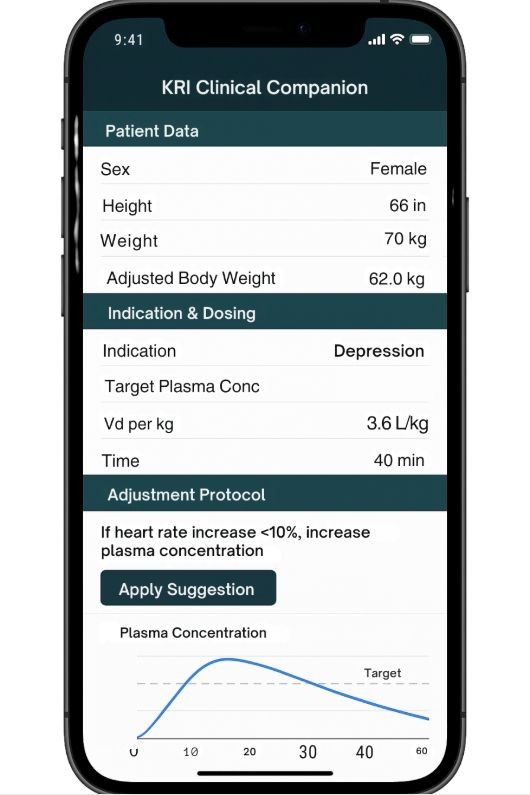
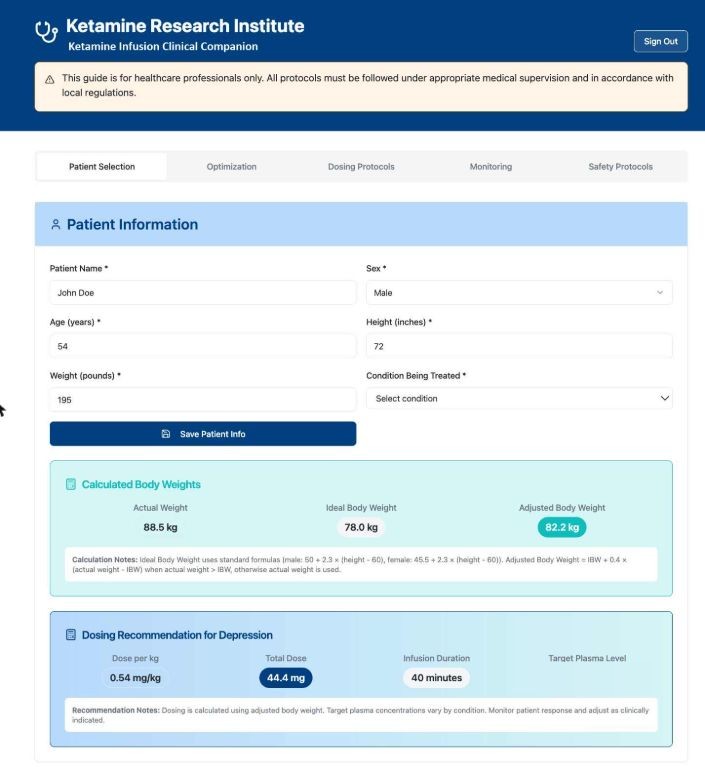
The KRI Clinical Companion app
Decision support built for this method and available to KRI graduates: a target plasma concentration from patient-specific factors, a live concentration curve during the infusion, pharmacogenomic and metabolic screening, medication-interaction checks, and session-by-session clinical notes.
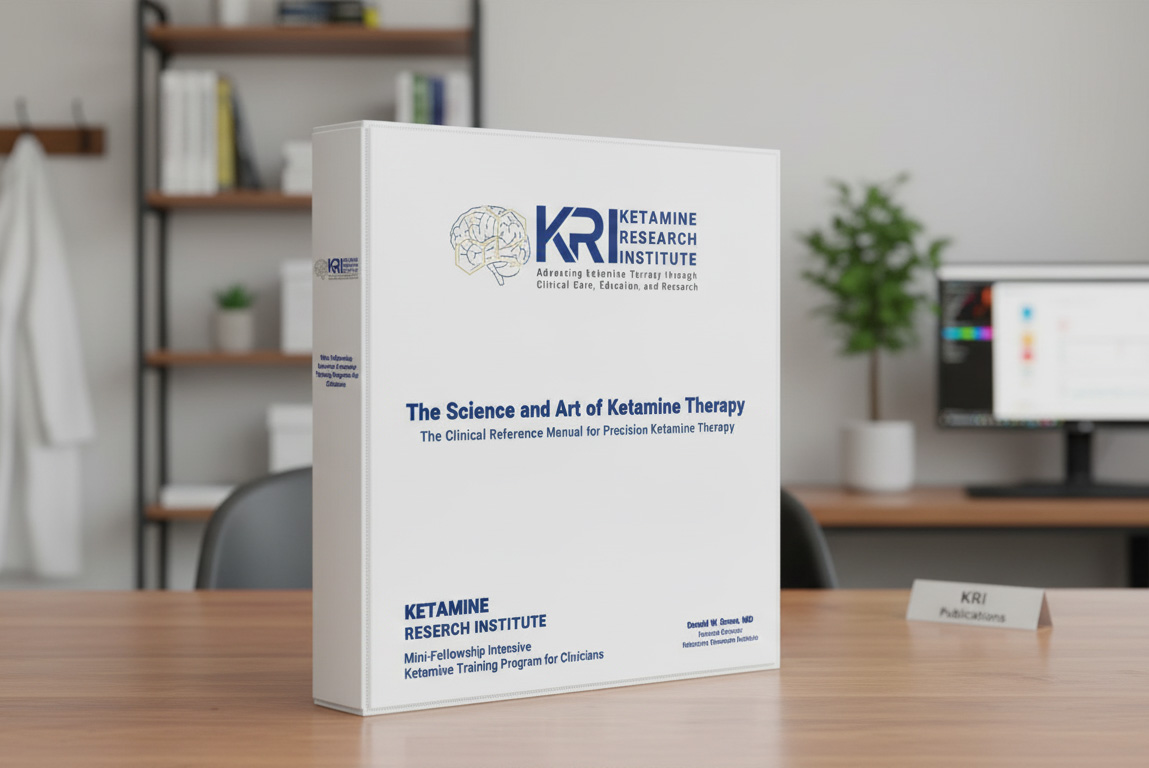
The Clinical Reference Manual
Dr. Grass’s desk reference: NMDA pharmacology, neuroplasticity, metabolic pathways, pharmacokinetics, interactions and contraindications.

KIRT-S risk screening
A short screening instrument used with your state PMP. It scores substance-use risk, psychiatric stability, medical and infusion safety, and treatment fit, and flags hard stops.

Business planning manual
Practice structure, space planning, staffing, equipment and vendors, per-treatment costs and financial projections.

The Clinician’s Marketing Handbook
A 110-page guide to describing your training and methods to patients and referring clinicians accurately and without overstatement.
Clinical documentation
- Initial evaluation template
- Validated psychiatric assessment tools
- Informed consent
- Pre- and post-procedure notes
- Infusion records
- Discharge instructions
Dosing and precision tools
- KRI Rapid Guide to Ketamine Infusions
- Pharmacokinetic dosing algorithms
- Adjusted body-weight calculators
- CYP450 interaction guides
- Pre-infusion metabolic optimization guide
- Ketamine Evaluation and Optimization Guide
Compliance and operations
- DEA controlled-substance program and logbooks
- Emergency response procedures
- Staff roles and training
- Scheduling and workflow
- Quality and outcome monitoring
- Equipment and vendor guidance

After the four days
A year of mentorship, and a credential that keeps being checked.
For twelve months, graduates have direct access to the clinical team for case consultation, dose and protocol questions, an unexpected reaction, a genetic result that needs interpreting, equipment choices, and the practical work of opening the service. Quarterly milestones keep the year structured, and a competency re-assessment closes it.
Graduates who complete the assessment can be listed in KRI’s directory of trained clinicians, and they stay in touch with the Institute and one another through the graduate network and regulatory updates.
And after the first year
The credential does not sit still, because the standard behind it does not.
Attestation is annual
The responsible clinician re-attests each year to the current edition of the KRI Standard, using the conformance checklist in Annex A.
The Standard is revised yearly
Each edition is written against a documented review of the evidence and the regulatory environment, and carries a change list naming what moved and why.
Outcomes feed back
From the opening of the KRI graduate safety registry, expected during 2027, attesting practices contribute de-identified aggregate safety data.
Three years after the course, a graduate’s competency has been reassessed and their conformance re-declared twice more, against a standard revised three times. What they hold is not a record of a week in 2026.
Who the program is for
One curriculum for every license in the room.
Pharmacology, concentration-based dosing and the monitoring standard do not change with the license. What each clinician brings to the course does.
Psychiatry
You know the patients. The course adds the anesthetic.
Pharmacokinetics, monitoring, airway management and infusion delivery, so the treatment you prescribe is one you can also give and supervise.
Primary care and internal medicine
You know the whole patient.
The course builds on your medical assessment with psychiatric selection, validated outcome scales, sedation practice and the systems an infusion service needs.
Anesthesiology and CRNAs
You know the drug in the operating room.
The course covers what differs in psychiatric practice: patient selection, subanesthetic targets, the dissociative experience, integration and outcome measurement.
Emergency and pain medicine
You know ketamine at the bedside.
The course adds indication-specific protocols for mood disorders and chronic pain, series design, and practice setup for an office setting.
Nurse practitioners and physician assistants
Scope and supervision vary by state.
The clinical content is the same. Confirm your scope of practice and supervision requirements with your state board before you plan an infusion service.
Requirements
To start the course
- An active, unrestricted professional license
- DEA Schedule III registration, if you will perform infusions
- ACLS, BLS and airway training are not required to start; airway management is taught in the course. Encouraged, and required by some states to run a service
- Written institutional authorization, if you are employed by an academic or federal institution.
Designed for community practice. The course prepares clinicians to open or improve an infusion service in their own office. Teams can attend together: clinicians, nurses and office staff.
Private and practice training
Training built around an established practice.
Practice-readiness tutorials
Private sessions for a clinician and their team, tailored to your practice model and your state’s requirements: protocols and documentation, controlled-substance handling, monitoring, airway and sedation readiness, staff roles and emergency preparedness.
Whole-team training
Prescribing clinicians, nursing staff and front-desk coordinators trained together, so every role in the service works to the same standard.
Private mentorship with Dr. Grass
A small number of clinicians work one-on-one with Dr. Grass, on a program built around their practice, their patients and their pace.
Three courses
Choose the course that matches where you are.
The Mini-Fellowship
You are starting an infusion practice
- New to ketamine or to infusion therapy
- Fifteen modules and a competency assessment
- Four days, then twelve months of mentorship
Advanced Training
You already run an infusion practice
- Experienced infusion clinicians
- Concentration targeting and precision medicine
- Two days, in person
KAP Training
You combine ketamine with psychotherapy
- Psychiatrists and KAP practitioners
- Precision dosing and TCI for the session
- Two days, in person

Course director
Gerald W. Grass, MD
Dr. Grass first used ketamine clinically in 1985 and has given thousands of hours of continuously monitored ketamine infusions since. He taught ketamine infusion to residents and fellows from around 2004, directed the Pain Medicine Fellowship at Yale, and led research on ketamine infusion for neuropathic pain at the VA Connecticut Healthcare System. In 2016 he opened this course to clinicians in private practice, and he teaches every session.
Graduates, in their own words

“The course provides a comprehensive understanding of patient selection, pharmacology, individualized dosing strategies, safety, monitoring, adverse-event management, and the practical aspects of building a high-quality ketamine infusion practice.”
“One of the most valuable components was the opportunity to personally experience a ketamine infusion. That experience provided insight and empathy that textbooks alone cannot.”
Luis Rosa-Fajar, MD · Emergency physician
“I needed the scientific approach of how to calculate what plasma concentration can work for whom and how to possibly change it.”
Rixt Luikenaar, MD · Obstetrics and gynecology
“Having the day-to-day forms, infusion notes, and protocol and SOP forms is just so exceedingly helpful.”
Edward Campbell, MD · AnesthesiologistQuestions clinicians ask
Before you apply.
Who can attend the Mini-Fellowship?
Licensed clinicians who give ketamine infusions or plan to: physicians in psychiatry, primary care, internal medicine, anesthesiology, emergency and pain medicine, and nurse practitioners, physician assistants and CRNAs. Staff members who will work in the infusion suite can attend with their clinician.
What do I need before I apply?
If you will perform infusions, an active, unrestricted professional license and DEA Schedule III registration. ACLS, BLS and prior airway training are not required to start, and the course teaches airway management for moderate and deep sedation. We encourage them all the same, and some states require certification, including formal airway training, to run a service.
Are patients treated during the course?
No. The supervised clinical training is a peer practicum: participants take the history, calculate the dose, place the line and manage the infusion for one another, under direct observation.
Do I have to receive an infusion myself?
No. The personal infusion is voluntary and separately consented, and declining it has no effect on your assessment or certificate. Two participants receive an infusion on Day 2 and two on Day 3.
What credential do graduates receive?
Participants who pass the final examination and the observed clinical assessment receive a certificate of training with a competency attestation and may use the KRI Trained and Certified Clinician mark. It is a certificate from the Ketamine Research Institute. It is not board certification and not an accreditation.
Is CME available?
Twenty-six Type II CME credits are available. Type I CME credit is not offered.
How large is each class, and when is the next one?
Each cohort is four clinicians, and KRI trains twelve clinicians a year. Sessions run Thursday to Sunday, through the year, in Sarasota, Florida: 8:30 AM to 4:00 PM on the first three days and 8:30 AM to 2:00 PM on the fourth. We set the dates with each cohort rather than publishing a calendar.
Is RESTORE taught in the course?
No. The RESTORE Infusion is proprietary to the Ketamine Research Institute and is performed only at the Institute in Sarasota. The course teaches the principles, pharmacology and methods that stand behind it. Participants are asked to sign a non-disclosure agreement covering KRI’s proprietary material.
Will I be listed as a graduate?
Graduates who complete the assessment can be listed in KRI’s directory of trained clinicians, which patients and referring clinicians use to find a KRI-trained practitioner near them.
Is the course suited to academic or high-volume practices?
The course is designed for community practice, where an individualized approach can be built into each patient’s care. Clinicians employed by academic medical centers, university health systems, or federal facilities should obtain written authorization from their institution before applying. The program includes a non-disclosure agreement and licensed tools that can intersect with institutional policies on intellectual property, outside activities, and patient data. We are glad to talk this through first.
Can the training be arranged privately?
Yes. Private sessions, and practice-readiness training for a clinician and their staff, can be arranged by request. Call 800-850-6979 or email training@ketamineinstitute.com.
Sessions
Set with each cohort
- Schedule
- Thursday–Sunday, 8:30 AM–4:00 PM, finishing 2:00 PM Sunday
- Class
- Four clinicians
- Location
- Ketamine Research Institute, 5969 Cattleridge Blvd., Suite 104, Sarasota, FL 34232
Travel and lodging → - Tuition
- $8,950
- CME
- 26 Type II credits. Type I CME credit is not offered.
Cohorts are capped at four
To keep the training hands-on, each session takes four clinicians. Sessions can fill well ahead of their dates, so contact us early if you want a particular one.
Speak with us first
We will answer your questions and arrange a time to talk with Dr. Grass about whether the program fits your practice. The conversation is informal.
800-850-6979training@ketamineinstitute.com
References
- Domino EF, Chodoff P, Corssen G. Pharmacologic effects of CI-581, a new dissociative anesthetic, in man. Clin Pharmacol Ther. 1965;6:279–291.
- Krystal JH, Karper LP, Seibyl JP, et al. Subanesthetic effects of the noncompetitive NMDA antagonist, ketamine, in humans. Arch Gen Psychiatry. 1994;51(3):199–214.
- Berman RM, Cappiello A, Anand A, et al. Antidepressant effects of ketamine in depressed patients. Biol Psychiatry. 2000;47(4):351–354.
- Zarate CA Jr, Singh JB, Carlson PJ, et al. A randomized trial of an N-methyl-D-aspartate antagonist in treatment-resistant major depression. Arch Gen Psychiatry. 2006;63(8):856–864.
- Sanacora G, Frye MA, McDonald W, et al. A consensus statement on the use of ketamine in the treatment of mood disorders. JAMA Psychiatry. 2017;74(4):399–405.
- McInnes LA, Qian JJ, Gargeya RS, DeBattista C, Heifets BD. A retrospective analysis of ketamine intravenous therapy for depression in real-world care settings. J Affect Disord. 2022;301:486–495.
- Peltoniemi MA, Hagelberg NM, Olkkola KT, Saari TI. Ketamine: a review of clinical pharmacokinetics and pharmacodynamics in anesthesia and pain therapy. Clin Pharmacokinet. 2016;55(9):1059–1077.
- Zanos P, Moaddel R, Morris PJ, et al. Ketamine and ketamine metabolite pharmacology: insights into therapeutic mechanisms. Pharmacol Rev. 2018;70(3):621–660.
- Li Y, Coller JK, Hutchinson MR, et al. The CYP2B6*6 allele significantly alters the N-demethylation of ketamine enantiomers in vitro. Drug Metab Dispos. 2013;41(6):1264–1272.
- Murrough JW, Perez AM, Pillemer S, et al. Rapid and longer-term antidepressant effects of repeated ketamine infusions in treatment-resistant major depression. Biol Psychiatry. 2013;74(4):250–256.
- Struys MM, De Smet T, Glen JI, Vereecke HE, Absalom AR, Schnider TW. The history of target-controlled infusion. Anesth Analg. 2016;122(1):56–69.
- Clements JA, Nimmo WS. Pharmacokinetics and analgesic effect of ketamine in man. Br J Anaesth. 1981;53(1):27–30.
- Zarate CA Jr, Brutsche N, Laje G, et al. Relationship of ketamine’s plasma metabolites with response, diagnosis, and side effects in major depression. Biol Psychiatry. 2012;72(4):331–338.
- Kamp J, Olofsen E, Henthorn TK, van Velzen M, Niesters M, Dahan A. Ketamine pharmacokinetics: a systematic review of the literature, meta-analysis and population analysis. Anesthesiology. 2020;133(6):1192–1213.
- Sakurai H, Jain F, Foster S, Pedrelli P, Mischoulon D, Fava M, Cusin C. Long-term outcome in outpatients with depression treated with acute and maintenance intravenous ketamine: a retrospective chart review. J Affect Disord. 2020;276:660–666.
- Grass GW. A new methodological approach to improve the real-world effectiveness of ketamine infusion therapy for treatment-resistant depression. Poster presented at: Psych Congress Annual Meeting; September 2022; New Orleans, LA; and 6th International Conference on Neurology and Brain Disorders; October 2022; Orlando, FL.