
The Mini-Fellowship › Method and science › Concentration-targeted infusion
Concentration-targeted ketamine infusion
The dose is what goes into the line. The plasma concentration is what reaches the brain, and it is not the same number for every patient. This page sets out what decides the difference, how anesthesia solved a version of the problem, and how the course teaches clinicians to work to a target.

For KAP practitioners. How you dose the session matters. Intramuscular: the dose rises to a peak and falls away, so the patient is workable only on either side of it. Concentration-targeted infusion: the patient is brought into the anxiolytic–empathogenic range and held there for the length of the session, with defenses lowered, calm enough to stay with difficult material and present enough to talk about it. One continuous working session, reproducible from visit to visit. See the two curves →
The problem with milligrams per kilogram
One number, set by weight alone.
The protocol most office practices inherited sets the dose by body weight: 0.5 mg/kg over forty minutes, borrowed from the small trials that first showed an antidepressant signal.9 Weight is easy to measure, and it is the only patient variable the protocol uses.
It is not, however, the variable that decides what happens. Clearance and volume of distribution differ substantially from one person to the next, and interacting medications move both. The result is that the same milligrams per kilogram can leave one patient below any useful level and take another past the point of comfortable sedation.
This is not a subtle effect. In the schematic below, three patients of the same weight receive the same dose, and the peaks land in three different places: below the target range, inside it, and well above it.
A clinician working from the dose alone has no way of knowing which of the three is in the chair. Nor is there a formula for it: the largest pooled analysis of ketamine pharmacokinetics, covering eighteen studies, found no patient characteristic that reliably predicts where an individual will land.11


All three patients weigh 70 kg and receive 35 mg over forty minutes. Body build sets the size of the central compartment (V1), the blood and well-perfused tissue the infusion first mixes into, estimated here as 15% of blood volume by Nadler’s equation; it differs by about 13% either way. That is not the same as ketamine’s much larger volume of distribution once it has spread through the tissues, described below. Clearance, metabolism and interacting medications, none of them visible in the patient, widen the spread further, which is why the level has to be planned for and then observed. Schematic teaching example; the values are illustrative, not patient data.
What actually decides the level
Six variables, none of them weight alone.
Volume of distribution
Ketamine is lipophilic and distributes into a large volume — a weighted mean near 252 liters per 70 kg across the published studies, and it varies widely between individuals.11 The same milligrams per kilogram do not dilute into the same space in every patient.
Clearance
Hepatic metabolism, mainly by CYP3A4 and CYP2B6, converts ketamine to norketamine and onward.3,4 Enzyme activity varies between people, and common variants slow the step.5
Interacting medications
Inducers and inhibitors of those enzymes move exposure in both directions, as do drugs that change hepatic blood flow.
Route
Intravenous delivery avoids first-pass metabolism; intramuscular, intranasal and oral routes each give a different and less predictable profile.3
Rate and duration
The same total dose given over twenty minutes and over forty minutes produces different peak concentrations and different experiences.
The patient’s state
Anxiety, sleep, hydration and concurrent illness all change how a given level is experienced, even when the pharmacokinetics are identical.
The window
Enough to work. Not so much that it tips into excess sedation.
Every infusion aims between two edges. Below the lower one, the experience is unlikely to do much. Above the upper one, the patient passes the state the treatment depends on and into excess sedation, with more side effects and less of the therapeutic content.
Working to a target means planning the infusion so that its peak, at the end of the forty minutes, lands between those edges for this patient, on this day — and then watching what happens rather than assuming it.
The specific target ranges are course material and are not published here.
The target window for a forty-minute infusion
Schematic. The aim is for the peak concentration at the end of the infusion to fall inside the target range. Sources: Clements and Nimmo 1981; Zarate et al. 2012; KRI dose–response data.1,8
Borrowed from anesthesia
Target-controlled infusion, and what it took from the operating room to the office.
Anesthesiology met this problem decades ago and solved it with pharmacokinetic models. Target-controlled infusion lets a clinician set a concentration rather than a rate; the model calculates what the pump must do to reach and hold it, and adjusts as the infusion runs.6,7
Ketamine’s pharmacokinetics have been described since the early 1980s,1,2 and reviewed in detail since.3 The arithmetic is not new. What the course does is apply it to psychiatric practice, where dosing has generally been left at a fixed number.
The method, step by step
- 1
Select the target
Choose the target plasma concentration for the patient’s diagnosis, from the ranges taught in the course.
- 2
Account for the patient
Adjust the target for the individual. A patient taking a CYP3A4 inducer, for example, may need a higher calculated target to reach the intended level.
- 3
Model the infusion
Enter age, sex, adjusted body weight and the adjusted target into a pharmacokinetic model of ketamine.
- 4
Run the infusion
The model gives the mg/hr rate for the syringe pump over the forty-minute infusion. Monitoring confirms what the patient is experiencing.
At the chair
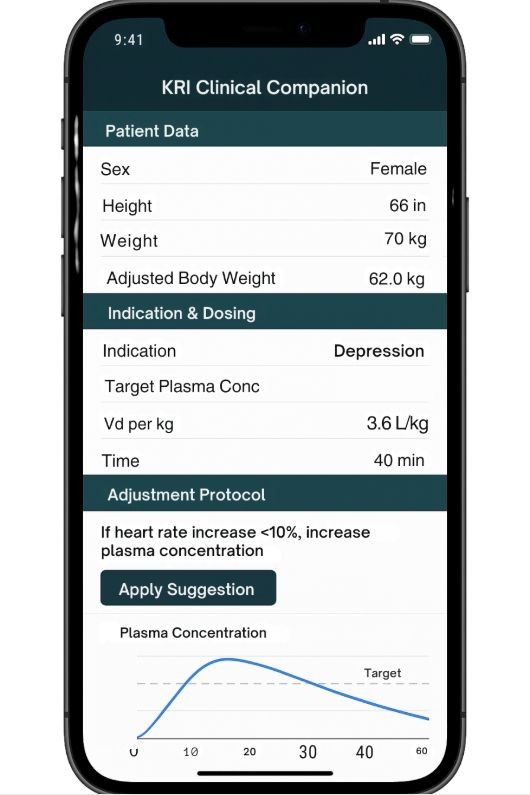
The Clinical Companion carries the model into the room.
Doing this by hand is possible, and the course teaches the arithmetic so that a clinician understands what the tool is doing. In practice, graduates use the KRI Clinical Companion, which holds the model, the patient’s factors and the record of what was decided.
Using it
Four points where the target is set, followed and recorded.
Step 1
Before the infusion
Patient factors, medications and any genetic findings are entered, and the app flags what should be addressed first.
Step 2
Setting the target
The target is chosen for the indication and then adjusted for the patient, with the reasoning recorded.
Step 3
During the infusion
A concentration curve tracks where the patient is, alongside the monitored parameters, so adjustments are made against a model rather than a guess.
Step 4
Afterward
The session is recorded, with the response measures that inform the next infusion.
Being straight about the evidence
What is established, and what is not.
What is established
Concentration-targeted delivery is routine in anesthesia, where target-controlled infusion has been in clinical use for decades and its models are well described.6,7
What is not
No randomized trial has compared concentration-targeted ketamine with fixed weight-based dosing for depression. Ketamine’s psychiatric use is itself off-label.
Why KRI teaches it anyway
Because the alternative — one dose for every patient — is known to produce a wide range of plasma levels, and because that range cannot be predicted from the patient in front of you.11 If it cannot be predicted, it has to be planned for and then observed. Dosing against a model can also be documented, reviewed and taught. Individual response is still measured on validated scales.
How it is described
As a method, not a promise. Graduates are asked to describe what they do and what the evidence supports, without claiming outcomes the evidence does not carry.
Ketamine is FDA-approved as an anesthetic. Its use for depression, chronic pain and other psychiatric indications is off-label, which means the FDA has not evaluated it for those uses.
Reading
References for this page.
- Clements JA, Nimmo WS. Pharmacokinetics and analgesic effect of ketamine in man. Br J Anaesth. 1981;53(1):27–30.
- Clements JA, Nimmo WS, Grant IS. Bioavailability, pharmacokinetics, and analgesic activity of ketamine in humans. J Pharm Sci. 1982;71(5):539–542.
- Peltoniemi MA, Hagelberg NM, Olkkola KT, Saari TI. Ketamine: a review of clinical pharmacokinetics and pharmacodynamics in anesthesia and pain therapy. Clin Pharmacokinet. 2016;55(9):1059–1077.
- Zanos P, Moaddel R, Morris PJ, et al. Ketamine and ketamine metabolite pharmacology: insights into therapeutic mechanisms. Pharmacol Rev. 2018;70(3):621–660.
- Li Y, Coller JK, Hutchinson MR, et al. The CYP2B6*6 allele significantly alters the N-demethylation of ketamine enantiomers in vitro. Drug Metab Dispos. 2013;41(6):1264–1272.
- Struys MM, De Smet T, Glen JI, Vereecke HE, Absalom AR, Schnider TW. The history of target-controlled infusion. Anesth Analg. 2016;122(1):56–69.
- Absalom AR, Glen JI, Zwart GJ, Schnider TW, Struys MM. Target-controlled infusion: a mature technology. Anesth Analg. 2016;122(1):70–78.
- Zarate CA Jr, Brutsche N, Laje G, et al. Relationship of ketamine’s plasma metabolites with response, diagnosis, and side effects in major depression. Biol Psychiatry. 2012;72(4):331–338.
- Zarate CA Jr, Singh JB, Carlson PJ, et al. A randomized trial of an N-methyl-D-aspartate antagonist in treatment-resistant major depression. Arch Gen Psychiatry. 2006;63(8):856–864.
- Sanacora G, Frye MA, McDonald W, et al. A consensus statement on the use of ketamine in the treatment of mood disorders. JAMA Psychiatry. 2017;74(4):399–405.
- Kamp J, Olofsen E, Henthorn TK, van Velzen M, Niesters M, Dahan A. Ketamine pharmacokinetics: a systematic review of the literature, meta-analysis and population analysis. Anesthesiology. 2020;133(6):1192–1213.
- Highland JN, Farmer CA, Zanos P, et al. Sex-dependent metabolism of ketamine and (2R,6R)-hydroxynorketamine in mice and humans. J Psychopharmacol. 2022;36(2):170–182.
- Rao LK, Flaker AM, Friedel CC, Kharasch ED. Role of cytochrome P4502B6 polymorphisms in ketamine metabolism and clearance. Anesthesiology. 2016;125(6):1103–1112.
Where this is taught
Modules 6 and 9, with Module 13 on the final day, and practiced at the chair on Days 2 and 3.